Blog

  • Make a pattern your own

    Make a pattern your own

    This pattern makes the scarf shown in the photo below on the left.

    These notes look like chicken scratch – I understand them, but the notes that I have in my pattern books aren’t for anyone else – just like when you are sharing a recipe with someone that you have memorized, you wouldn’t just give someone a list of ingredients and say go for it and expect the same results.

    To me, this means something and I would use this again to remind myself how I started a particular scarf.

    There are so many patterns that I know that I just sometimes look at a yarn and think that would be great in a shell stitch or basketweave. The same yarn can look quite different when a different stitch pattern is used. The hook make a difference but the stitches also make a difference as well. It the same when you give someone ingredients to create a meal and you might not get the same dish – it’s all about how you make it.

    Same yarn different patterns…
    Same yarn different patterns…

    When I make afghans, I may plan or I might just buy some yarn that I like and go from there. Rarely have I ever decided to make something specific, purchase the yarn for it and have the pattern already planned. Generally tat’s for gifts and I know the recipient. It’s likely that I may never meet the recipients of the hats, scarves and afghans that I make, so I just have to go with the feeling. It sounds hokey but it is, Just as someone can look at ground beef and decide to make hamburgers, meatloaf, tacos or sloppy joes, a skein of yarn can become almost anything. The possibilities are mind boggling!

    Try a different stitch pattern with the same yarn or even change the hook size to one larger than you normally use – the drape will change and you will see things differently. Using a different size hook or a hook made of wood instead of metal may change how you feel about a yarn.

    Explore the possibilities with yarn!

    Happy crocheting!
  • Ripping and re-crocheting!

    Ripping and re-crocheting!

    Want to get it right this time
    Want to get it right this time
    Want to get it right this time
    “Complicated” – Poi Dog Pondering

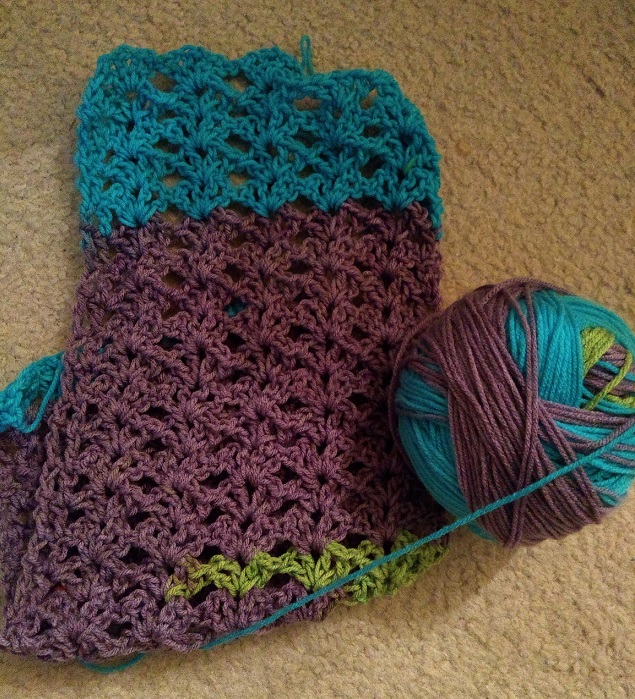
    This is how I feel when I have to frog projects and rip things out. Only to have to rip out a section and start again. I tried a new-ish stitch pattern. I liked how it turned out the first time I tried it with a different yarn and thought that the stitch pattern would look nice in a color changing yarn. It did but the yarn was a heavier weight and made it a difference in the drape. At the end of the rows it started curling up. The rows were the same width but there was a slight curl on the edges like a soft ripple.. I persevered. Then when I added another skein of the same yarn, same dye lot, same hook, same stitch and everything… something happened. The rows got wider. I had mistakenly added a stitch. So I ripped everything out from that section and began again. It happened again. I checked and counted and there were the same number of stitches but my gauge was totally off with the addition of this new skein. I tried a third time. Same thing.

    Then I decided to give up, rip it out and find a new stitch. I only did a couple of rows because I unraveled, and rewound and started fresh in an open shell stitch [Star stitch, from the Crochet Bible], one that I hadn’t done in a while. It’s similar to the Iris stitch that I started in the current lunchtime scarf. It’s started out better than the previous one and I don’t think my gauge will vary. Some stitches work best with lighter weight yarn to create a better drape with the yarn. The heavier the yarn, the “less fiddly” or rather, simpler the pattern should be because the weight of the yarn is an element itself and changes the drape.

    I add an additional border when I work on many scarves because I like to have something sturdier to work on, the edges are sturdier and I do the same in scarves that I make for myself.

    Here’s the pattern that I used – the stitch pattern calls for a multiple of 4 plus 1, plus 3 for the starting chain. I eliminated the 3 for the starting chain because I start the pattern on what would essentially be the third row, because I want to (again) have a more substantial foundation. Instead of just a double crochet (or one turning chain) at the ends I have two double crochets at the ends (one ch 2 at the end and one double crochet).

    The pattern I used with the single crochet starting row and additional stitches at the ends goes like this:

    Chain 26,
    turn, single crochet in 25 chains to end of row
    Chain 2, turn

    Dc in second chain [chain 2 serves as dc], sk 2, [in the fifth single crochet in row] *dc, ch 1, dc, ch 1, dc, ch 1, dc; skip 3 *, repeat pattern * * until there are four stitches left in row; skip two, dc in last two, chain 2, turn.

    Repeat row three to desired length, single crochet in last row.

    [Note: Depending on the yarn and hook, I may chain 3 at the end of each row so that the stitches aren’t as tight and drapes better.]

    Writing it out make this seem more complicated than it is but the results are great. Once you get the hang of it, the project will work up quickly.

    Happy Crocheting!

  • Infatuated with stripes

    Infatuated with stripes

    I am currently excited and infatuated with stripes in scarves. I do like self-striping yarns, but I want to be able to control the stripes. Though scarves are on the menu for this year there are still small bits of yarn remaining that will make some interesting stripes. When I first made some scarves years ago, I just used an eight-ounce skein of Red Heart or some other yarn and that was enough to make a scarf. I generally used eight ounces as my rule of thumb for making a scarf, which worked if I was doing something that wasn’t a “yarn-eating” stitch pattern – shells, basic single, half or double crochet. Doing something more elaborate such as a wider or longer scarf meant that I needed more yarn. Scarves done in front or back posts take more yarn.

    When yarns were in eight-ounce skeins that was convenient but as I moved into other brands or different yarns I needed more. Though I tend to use acrylic or wool for scarves, I may need to buy more than just eight ounces. What to do with all the remaining yarn – put them together and make stripes. Every few years I tend to gather all my odd balls and make a scrapghan. This year’s version of that is going to be scarves with stripes.

    Right now, I have two scarves that I am making with vertical stripes – so working nine or ten horizontal rows of 224 chains to make vertical stripes. One was planned with two yarns in mind – a chocolate brown yarn that I bought to do with a wool that I bought in a thrift store. The other is using leftover yarn from a scarf combined with gray. The odd balls are still going into my yarn bowl for future use, but when the yarn is more than half a skein, I earmark it for several rows of stripes. Two to three ounces of worsted or aran weight yarn (or 100 yards or more) can make a nice wide stripe or a couple of colors can be used to make a few stripes of color. Larger balls of remaining yarn are better suited for stripes in scarves or afghans rather than the pops of color in a scrapghan.

    The gray yarn is ready and waiting for lots of stripes. Since I’m making the hats in the same red yarn and can make at least two, maybe three hats from a skein or just join another skein and keep going. It’s not likely that I’ll use that red in a striped scarf, but red may make a cameo appearance.

    I’m definitely infatuated with stripes for now, especially I am able to control the pattern, make unique scarves and use up yarn.

    Are you currently smitten with certain patterns, colors, yarns or motifs? Let me know…

  • Sabbatical year reflections – scarves and hats

    Sabbatical year reflections – scarves and hats

    What I have learned during my sabbatical year which could also be called my year of scarves and baby hats is that my gauge for my foundation chain is very firm and depending on the stitch pattern, it’s a bit too tight. To combat this, I chain more loosely or need to go up a hook size for the foundation chain. This is only an issue if I am making scarves with a long starting row, several wide horizontal rows, instead of creating the scarf with lots of short vertical rows.

    Another lunchtime project – which a friend says looks like bacon a.k.a. The Bacon Scarf

    I am solidly a worsted /Aran weight girl, bulky is too chunky for me and I’m not a DK person.

    Working on several scarves at a time keeps my memory sharp, it’s never too early to start working on braining training exercises. I generally complete a hat in one setting, so I can remember the pattern that I’m working on, but when I am working on several different scarves at a time, one at work, one upstairs by my bed, on that I started in my knitting group, one downstairs I may forget what I started working on. Especially since I’m not working from written patterns or the stitch pattern is “in my head.” To make the process easier, I keep the hook with the project, regardless of how long I put a project aside. Since I rarely use the suggested hook on the label, I can’t use that as a guide. I have several multiples of the popular hook sizes that I use and at least I don’t have to work out what size hook to use and to remember the stitch I was doing.

    For many yarns that is always a little left over, so I purchased some gray and I will make some scarves with fun stripes. I like a medium gray as a neutral to make the colorful stripes pop. If it can be done in larger projects, why not on a smaller scale?

    Another thing that I have learned is that I think about what I like in a scarf, not necessarily the color, but in the warmth, so I try to use stitches that don’t have a lot of open spaces to increase warmth. Just because I don’t like certain colors, doesn’t mean that someone else won’t. I would probably stick to blues and shades of brown if I chose what I like. There are many colors that are bright but won’t show a lot of dirt and add a touch of color or whimsy to our winter gear, which is necessary, sometimes to be seen when it is dark and to recognize your own items instead of just a sea of black.

    I like the fast results I see: finishing up a hat in one or a few in one sitting or a scarf in a week or so in fits and starts. Portable projects are fun.

    More front and back post work

    Earlier this year, I said I wanted to do more than front and back post work, specifically basketweave, but the combinations and multiples of posts make it possible to have something different and unique and keeps me interested. Combining different stitches or the same stitch in different yarn or direction makes it fun. My sabbatical year has been fun so far, because projects are finished so quickly.

    Happy Crocheting!

  • Pick a winner

    Pick a winner

    Three attempts and I finally got something I wanted to continue to work on. Only those who are creative (not only with yarn) will know how it feels to work on something until you get it “right,” or at least until it feels right enough to continue working on it.

    Trial #3

    Some yarns lend themselves to certain patterns or techniques. There are no hard and fast rules for what can be done with a particular yarn but when you want to make something that doesn’t let too much air in or has some drape, even if it is a cozy item for warmth, picking the right yarn is essential.

    Even the difference in color could change what the final project looks like. What’s important is whether or not you are happy with the creation. An idea in your head may not match the expectation or the execution – keep going. I had an idea in mind for a scarf designed horizontally on the long edge and after a couple of rows it didn’t work out. I took it apart and then made something I was pleased with. I think the idea will work with a different yarn or maybe I need to make some changes to the idea that I sketched out.

    Failures in crafting don’t mean that we give up; failures could lead to better ideas and greater inspiration. If you try a technique that is all the rage, or seems to be according to your Ravelry or Facebook groups; and just doesn’t do it for you, this doesn’t mean that you can’t try a new technique. Just like fads and certain fashions – everything doesn’t work for everyone. Explore new territory, look through motif and pattern books to find what suits you, for most people, this is a hobby and should be fun and interesting.

    We can’t always pick a winner unless we stick to what we know, which can lead to fatigue and boredom because there is no challenge. Try a new technique, or a familiar technique in a yarn that you haven’t used before. Keep testing the waters and challenging yourself. This will keep you interested and your skills sharp.

  • Who’s your cheerleader?

    Who’s your cheerleader?

    “She didn’t get it from me.”

    I was with my mother and a lady we know complimented me on my hat and scarf set. She said I did a good job and then looked at my mother. My mother said as she often does: “she didn’t get that from me. I have never known how to do that, my mother either.”

    This image has an empty alt attribute; its file name is brightgreenfinished.jpg
    Latest finished “lunchtime” scarf

    My mother is a talented lady in many ways, and has never crocheted nor showed a desire to learn, BUT she is supportive and my champion. She bought me my first full set of hooks, which I still have, bought me the materials I needed when I said I wanted to learn and bought crochet books for me.

    She and other family members tease me about crocheting, but they also tell other people about what I do or show off what I have made for them. It’s not just about having someone who acknowledges that you can do something or that you like to do something , but someone who will recognize your ability to make nice things.

    Having someone who is supportive of your hobby or craft is also crucial to your well being. Studies talk about the calming effects of knitting and crocheting, but what about those who may have someone laughing at them or ridiculing them for being a non-traditional person practicing the craft or who is just starting out and is still developing their skills? The studies don’t talk about people who like to craft but are too self conscious or who are just starting out and had their loved ones laugh at what they make.

    Surround yourself with supportive friends, whether they craft or not. I have friends who will unsolicitedly say she made that hat, scarf, skirt, or whatever I’m wearing that I’ve made or will show off what I have made for them. If your family isn’t supportive, then having friends who are helps. You can stand up for yourself and your craft, it is the confidence in yourself that helps with your peace of mind as a person and a crafter. Creative projects should give you peace and contribute to your well being. If someone in your life doesn’t create, but supports your work, it adds to your joy.

    Keep crafting, friends!

  • In a charitable mood?

    In a charitable mood?

    Many of my friends who work with yarn are knitters. I participate in a regular group and sometimes I’m the only crocheter there. This doesn’t bother me. I’ve been going to meetings long enough that they just tease me about how fast I crochet. I don’t think I go particularly fast, it’s a medium speed. Not everyone likes to work on the same type of projects or use the same type of yarn, which makes me think of even though there are a lot of people who like to craft for charity, they don’t choose the same types of recipients. A few years ago, on a trip, I met a lady who made angel blankets, and another lady who knitted knockers for ladies who had mastectomies. Once in a while my friends will send me links to groups soliciting crocheted or knitted items. I have a few groups that I actively support and after searching, I found a few organizations that I may spread some crochet love to as well. Just like there are crocheters and knitters; there are those who like big bulky yarns and those who like lace weight yarns. For charities, there are people who want to make things for animals or people and everything in between.

    Current “at work” project

    I prefer to make items for people and have made scarves for Foster Care to Success, as well as local distribution and red hats to raise awareness for congenital heart defects for several years. I have also made hats for shaken baby syndrome (purple hats) and special olympians when it was a national project.

    Those are my choices. Some crafters are more passionate about wildlife or cancer patients or special olympians. There are more than enough groups to make something for and many groups could probably still use donated items, because there is always a need and things do wear out.
    If you are in a charitable mood and don’t know where to begin, here’s a list that I’ve compiled from a quick search on Google. Here are a few charities soliciting handcrafted crocheted or knitted items:

    If you want to make it, there is probably a charity for it, if not, start one and fill the need.

  • Yarn speaks

    Yarn speaks

    Sometimes projects just don’t work out right. So then I unravel them, especially if I like the yarn. If I don’t like the yarn, I will take it and then ditch the whole project, generally in the donation bag. Someone else may like it.

    My scepter of power – the nostepinne

    In my quest to work on cables or a variety of different designs for scarves, I tried working on a scarf that I with a variety of post stitches other than basketweave. When I started this, it seemed as though it would work well, but it didn’t quite work the way that I wanted it to. After an entire skein, in a color that I immediately loved, but probably wouldn’t buy because I received it in a mystery bag that I purchased from Premier yarns. One skein in I didn’t like how the scarf was curling in on itself. I used my scepter of power – my nostepinne and deftly unwound the third of the scarf that I’d made so that it is ready to add to the scarf that I started with the yarn – in basketweave. Same hook, same yarn, different stitch.

    Unraveled the one on the right,
    moving forward with the one on the left

    Not every yarn is right for every project. I use this same yarn to make little red hats and when doing that, I want a more tightly woven hat and use an I hook, for this scarf, I was using a J – a full two sizes up and I like the outcome.

    Most recent hat

    Sometimes the yarn just makes it into what it wants to be. Today, I made a hat using the same pattern that I have used before and it turned out to be a preemie-ish hat. The circumference is 12 inches instead of 13. I don’t actively make preemie hats since I found that there isn’t as much of a need for them. I made a hat using the same pattern a few weeks ago and the hat came out a little wider. There are times when I believe that yarn has a mind of its own, has a creative voice and decides what it wants to be in some cases.

    Maybe it’s not just a fallacy that someone needs to find the right yarn for a pattern or the right pattern for a specific yarn. Yarns speak, we must listen and make what the yarn wants to become.

    Happy crocheting!

  • Empowered to say no

    Empowered to say no

    Many people ask me to make things for them or for others and I politely tell them no. It’s not that I don’t enjoy making things, I do. There are at least six WIPs (works in progress) at tucked away in various places. I love having dozens of items to donate to people in need, but I like to make the items on my terms. After a long challenging day at work or even during my lunch break, I like to be able to have something calming and relaxing to do. When I finish, I finish. Crocheting is not as much fun if there is a deadline involved. I can count on one hand the number of times that I have sold things that I have made – a scarf for a friend’s mother. A lady from church asked me to make baby dresses for her twin granddaughters and gave me money for materials and labor, and a friend gave me money to make a hat for her pet. That’s it. A couple of people ask me to make things for them and offer to pay but I refused because they were definitely crochet worthy.

    There was a time when I didn’t crochet in public alone because I didn’t want to talk to people, never mind that I had no problem going to my knitting group and sometimes being the only crocheter, I was fine with that because there is safety in numbers.  Many times, if you are alone, “in the wild” people will ask – how much do you charge for an item.

    I have found many creative ways to respond to the question: “Would you make me a….?” or with the follow up… “I’ll buy the materials.” Sometimes people are asking me to make them something because they think they can get the item cheaper especially if they are only offering to buy the materials, though when they find out how much yarn costs for the item they want, not even considering the cost of my labor they are uninterested. I am not interested either because the time that it takes to make a scarf with a moderate pattern, such as basketweave, posts or shells and my hourly wage, the scarf would start at roughly $125 with materials.

    Instead I prefer to say no and just make things on my own terms. “Oh, I prefer to make things to give away,” or “I have so many groups that I am committed to making things for, that I don’t have time to make anything for you right now. Maybe in a few months,” or just politely smile and laugh as if you thought it was a joke. Sometimes I just ignore them, especially if the request isn’t made face to face. There are times when people who can craft want you to make them something, in those cases, I offer to teach them.

    Yes, I could sell what I make. I don’t want to. For certain people I know that they are crochet worthy and will appreciate what I give them and they might even ask for another item. Crocheting as a process is a hobby and also philanthropy for me. I want to do it, being hired by another person to make something for them for money, sucks the joy out of crocheting. Sometimes it’s the challenge of making an item – such as a hat a former Sunday school student asked me to make or a friend who asked me to make a hat for her pet. Other times, Its’ what I would like someone to have.
    It’s empowering to say no to people, especially when you want to practice your hobby for fun.

    Say no, when someone asks you how much you would charge for a baby blanket. Say no when someone asks you how much it would cost for a hat or a scarf or a sweater or a throw. No one is stopping you. Take control of your craft! If you want to sell what you make or have someone purchase the materials, do it. If you don’t want to sell what you make do that too. No one makes the rules, you are empowered to say no. Say no to giving your things away without being appreciated if you don’t want to; say no to selling anything if you don’t want to… craft how you like and enjoy your hobby!

    Happy crocheting!

  • Trying something new

    Trying something new

    One of my goals for this crocheting sabbatical year is to try different techniques one of which is cabling. My first attempt which was based off of a tutorial I saw on YouTube has not sold me on the idea of cabling. In my crochet reference library I found a pattern book with a variety of crocheted Celtic cables. Knowing how to do front and back post work is a foundation of working cables. I worked on a sample which I was going to use as a scarf and I’m not excited about the outcome. There are some other patterns that I might like better but my first cabling effort didn’t thrill me. Since I have the basics under my belt, so to speak, I am going to look for some other cabling patterns that aren’t as bulky. That’s what I didn’t like about it the bulkiness. If I use a thinner yarn, then the non-cabled portion of the pattern will not give the rest of the fabric the thickness that I want.

    There are enough crafts to suit everyone and even in those there are preferences. I have friends who knit and strongly prefer laceweight, others who only work on socks and I know crocheters who like to work with thread and other fiber artists who prefer bulky. There’s enough variety of yarn and thread to work with so the craft will never get boring. I am going to keep working on cables before I completely give up on them.

    I want to expand my horizons and try out more patterns and motifs. I haven’t given up, I’m still excited to keep trying cabling before I decide that this isn’t for me. Knowing how to do something and enjoying it are two different things. Until I have tried a few more patterns, I can’t truly say that I don’t like cabling. For now, it’s back to the search for the right pattern – one that I will enjoy and actually use and draw upon from my memorized crochet repertoire.